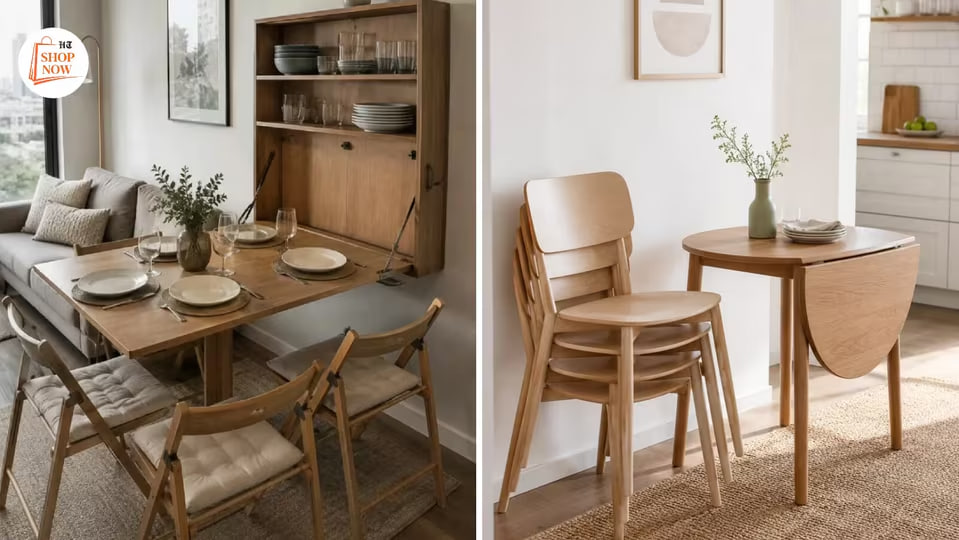
No space for a dining table but still want one? Here are space-saving options that add convenience without crowding your home.
Moving from a PG to a flat, I noticed one thing about living in urban cities, and that is the problem of space. There is hardly any space to add multiple pieces of furniture, and being someone who loves having a dining space, I am honestly a bit disappointed. Recently, my Instagram feed has been flooded with foldable furniture, so I thought of scrolling through some options. Honestly, I am a bit fascinated by how these can save space while still offering convenience. But what about the chairs? Well, they come in foldable designs too. Here’s what you can scroll through.
1. Wall-mounted folding tables
A wall-mounted folding table is a practical option for homes where there isn’t enough room for permanent dining furniture. It can be folded down when not in use, leaving more floor space available for movement. Depending on the design and placement, it can work in a kitchen, a narrow dining corner or a studio apartment.
What to look for: A sturdy folding mechanism, a stable table
2. Drop-leaf dining tables
If you need a dining table that can accommodate different numbers of people, a drop-leaf design is worth considering. These tables have hinged sections that can be lowered when they are not needed and raised to create a larger surface for meals. A drop-leaf table can be placed against a wall with one leaf folded down, then opened when you need additional space. Some designs also include shelves or drawers for storing dining essentials, although the storage capacity varies by model.
What to look for: Secure hinges, stable legs, a practical tabletop size and an easy-to-operate folding mechanism.
3. Compact round dining tables
A compact round dining table can help make a small dining corner feel less crowded. Its curved edges eliminate sharp corners, which may make it easier to navigate in a tight layout. Depending on the size and base design, it can also be positioned in a corner of the living room or kitchen. This option works best when you have enough space to pull out chairs and move around the table comfortably. A round table is not automatically more space-efficient than a square one, so compare the overall footprint before deciding.
What to look for: A tabletop suited to your household size, a stable base, enough legroom and chairs that can be tucked underneath when not in use.
4. Breakfast counters and bar-height tables
If your kitchen already has a counter or peninsula, it may be possible to use part of it as a dining area instead of introducing another table. A separate narrow breakfast table or bar-height table can also be an option when the layout allows it.
What to look for: A comfortable height, adequate knee space, stable stools and enough clearance around the kitchen work area.
5. Nesting tables for flexible dining
Nesting tables are usually associated with living rooms, but they can also serve as a flexible alternative for occasional meals or snacks. The smaller tables slide beneath the larger one when they are not required, reducing the space they occupy.
What to look for: A stable frame, easy-to-store sizes, a suitable tabletop height and surfaces that are simple to clean.
6. Multipurpose desks that double as dining tables
In homes where every piece of furniture needs to serve more than one purpose, a compact desk can double as a dining table. This can be particularly useful if you already work or study from home and have limited space for separate furniture. A narrow desk placed against a wall can provide a surface for meals and everyday tasks. After eating, it can be cleared for work or study. However, consider how often you will need to switch between the two uses, as a desk covered with books, cables or work equipment may not be practical for dining.
What to look for: A wipeable tabletop, adequate depth for plates and cutlery, comfortable seating clearance and enough space to keep work items organised.
What should you consider before choosing a dining table alternative?
Before purchasing space-saving furniture, measure the area where you plan to place it. Check the table’s full dimensions when open, the space needed for chairs, and the clearance required to move around it. A table that fits against a wall may still obstruct a doorway or kitchen cabinet when in use. For someone living alone or a couple, a small folding table may be enough, while a family may need a larger surface that expands when guests visit. If you rent your home, check whether drilling into walls is permitted before choosing a wall-mounted design.
Finally, prioritise stability, durability and ease of cleaning over appearance alone. Furniture used for dining should provide a reliable surface for plates, glasses and serving dishes, even if it is designed to fold away or serve multiple purposes.